

Can a browser wallet’s transaction simulation actually stop costly mistakes?
Ask a DeFi power user what keeps them awake and you’ll hear two recurring fears: signing a transaction you don’t fully understand, and waking up to drained approvals. That double worry frames why transaction simulation — the feature that replays a proposed on-chain action and reports exact balance changes and fees before you sign — is not a nicety but a practical control for active traders. This piece examines how Rabby’s browser wallet implements simulation in practice, how it changes the threat model for U.S.-based DeFi users, where the protection stops, and how to make a decision when choosing a multi-chain wallet.
The goal here is not to advertise but to explain mechanism, trade-offs, and limits. I’ll walk through how pre-transaction simulation works technically, why it matters for multi-chain workflows (including gas-top ups and automatic network switching), the real security benefits versus residual risks, and a decision framework you can use the next time you choose or configure a wallet for substantial on-chain activity.
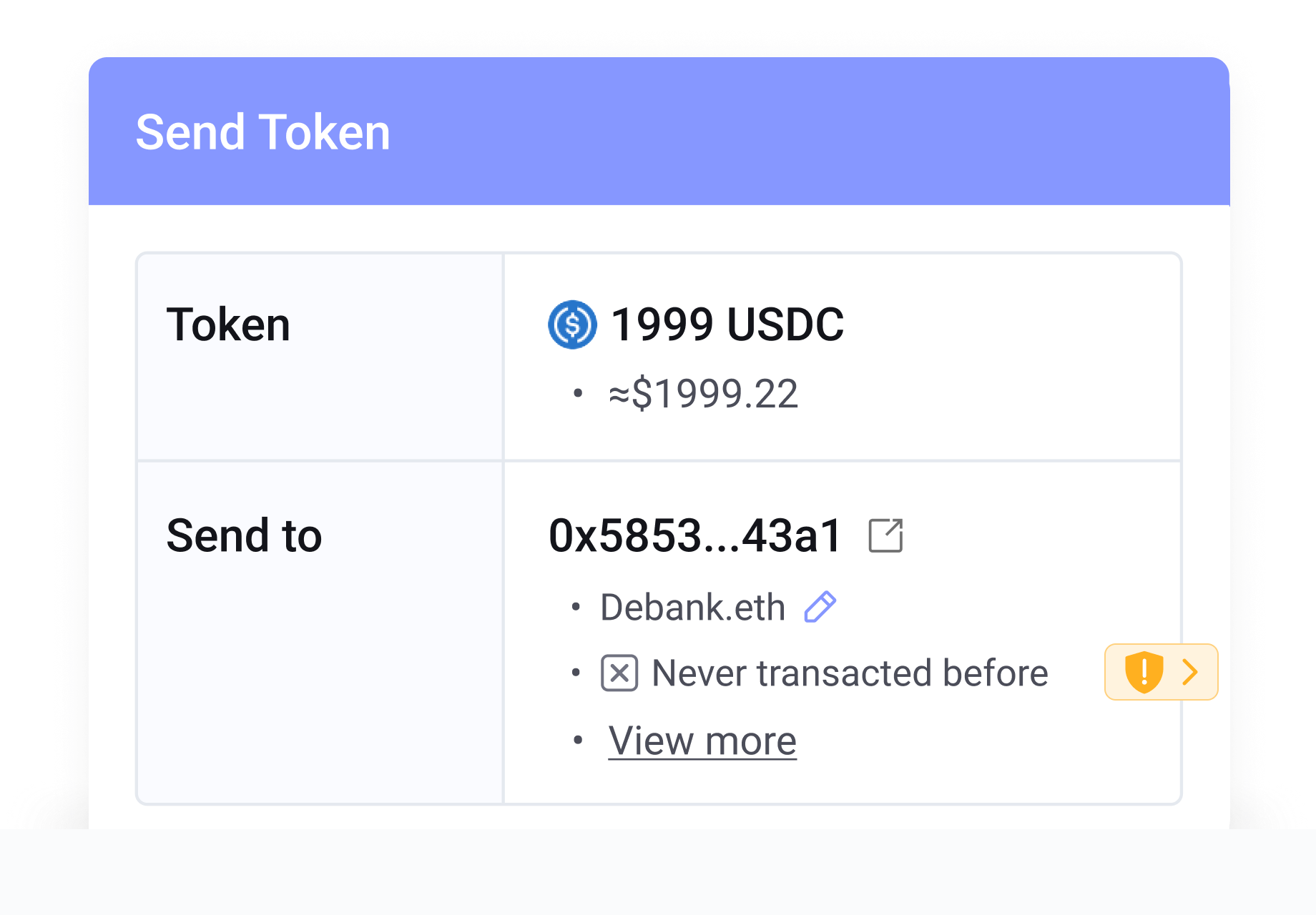
How transaction simulation works (mechanism first)
Transaction simulation replays the exact transaction payload — the contract call, parameters, and value — against a node or local EVM execution context before you sign it. The wallet assembles a replica of the blockchain state (or queries a node with the current state), executes the contract bytecode off-chain, and reports the resulting token transfers, contract calls, and gas used. That’s what Rabby does: instead of letting you “blind sign” a contract call, it shows estimated token balance changes and fee costs so you can compare intent to effect.
Mechanically, simulation depends on three inputs: the transaction data you would sign, a reasonably up‑to‑date state (block height and account balances), and a deterministic EVM execution environment. When those inputs are correct, the simulation gives an accurate, near-certain preview of on-chain outcomes. But the match between simulation and final result is only as good as the state snapshot and the assumption that nothing else alters state between simulation and broadcast (for example, frontrunning, reorgs, or mempool replacements).
Why it matters for a U.S. DeFi power user
For an active U.S.-based DeFi participant, value accrues from three practical changes simulation enables:
1) Reduced blind-sign risk. Instead of signing a generic approval or an opaque contract call, you see line-item effects: «You will lose X tokens; you will receive Y tokens; gas will cost Z.» That reduces social-engineering and UI‑based deception attacks which rely on users accepting opaque prompts.
2) Safer approval management. Rabby’s combined simulation and native approval revocation means you can inspect pending approvals, simulate what they would allow a contract to do, and then revoke approvals when they’re too broad. That closed loop — simulate, review, revoke — materially lowers exposure from long-lived, excessive allowances which have caused many losses in the space.
3) Cross-chain convenience without the usual blind spots. Multi-chain activity introduces operational friction and risk (wrong chain, missing gas). Rabby automates network switching and offers cross-chain gas top-ups; simulation reveals the precise costs and balance changes across those chain hops so you don’t misestimate a multi-step operation.
Where simulation meaningfully reduces risk — and where it doesn’t
Simulation reduces a class of user-facing risks: ambiguous UI prompts, hidden token drains embedded in contract logic, and odd approval semantics. But it’s not an all-powerful protection layer. Important boundaries:
– Time-of-execution differences. If state changes between simulation and broadcast, the on-chain result can differ. This matters for highly competitive DeFi actions (front-running, sandwiching) or for contracts whose behavior depends on pool state that moves rapidly.
– Oracle-dependent or randomness-dependent logic. If a contract uses an external oracle or on-chain randomness resolved after your simulation, the simulation can’t predict the future value an oracle will deliver.
– Malicious or buggy node/data sources. Simulation requires a trustworthy state snapshot. If the wallet uses compromised or stale node data, the preview is misleading. Rabby’s open-source architecture helps here because third parties can inspect how state is obtained, but it does not automatically guarantee the node is honest.
Trade-offs: simulation vs. other security controls
Simulation is powerful but not free. It adds latency to the signing flow and increases reliance on accurate RPC endpoints. Compare it to other controls:
– Hardware wallets: these protect secrets against device compromise but still allow blind signing; pairing a hardware device with simulation covers both secret security and intent verification. Rabby supports Ledger, Trezor, Keystone and others, so you can combine both controls.
– Multi-sig setups: these require multiple approvals and prevent single-key theft. Rabby integrates with institutional solutions like Gnosis Safe and Fireblocks; simulation still matters inside a multi‑sig workflow because signers need to understand the aggregate effects before they co-sign.
– Third-party scanners: independent security engines can flag known hacked contracts or suspicious approvals. Rabby bundles pre-transaction risk scanning to surface these signals alongside simulation results — complementary, not redundant.
Non-obvious insights and corrected misconceptions
Misconception corrected: simulation is not just a “nice UX feature”; it changes the adversary calculus. Attackers who relied on social-engineered blind signing must now also craft transactions that pass a human-readable simulation. That raises the bar but does not eliminate motivated attackers — it shifts attacks toward manipulation of simulation-friendly fields (for example, hiding sweeps inside multi-call transactions or engineering state-dependent behavior).
Non-obvious insight: the usefulness of simulation scales with the user’s operational profile. A large, frequent trader benefits more because a single prevented mistake saves more capital; casual users gain little relative to the extra friction. For institutions and active traders, pairing simulation with hardware wallets, multi-sig, and approval revocation is a compound mitigation strategy that meaningfully reduces operational risk.
Decision framework: when to download and use Rabby as your browser wallet
Use this heuristic: if you operate on multiple EVM chains, interact frequently with new dApps, hold material balances, or manage institutional funds, prioritize a wallet that combines multi-chain support, transaction simulation, and approval management. Rabby meets these conditions: it supports 90+ EVM chains, does pre-transaction risk scanning, offers in-wallet revocation, and integrates with hardware wallets and multi-sig tools. For those reasons, it’s a practical candidate for power users who want a richer safety surface than basic extension wallets provide. You can find the official resource page for downloading and researching rabby.
But apply three filters before committing:
– Operational complexity: are you willing to accept slightly longer signing flows? Simulation will slow some fast trades.
– Remaining gaps: there’s no native fiat on-ramp or native staking in-wallet. If you need these features, you’ll rely on external services.
– Historical risk tolerance: Rabby had an incident in 2022 involving Rabby Swap; the team froze the contract and compensated users, and they increased audits. The incident shows two things: vulnerabilities occur in any complex system, and how a team responds (freeze + compensate + audits) is a relevant signal when assessing trust.
What to watch next (conditional scenarios)
Two conditional developments would change the calculus for power users in the U.S. First, if wallets begin bundling on‑ramps and native staking securely, you’ll see a migration toward “one-stop” platforms; absent that, users will continue using dedicated services for fiat rails and for staking. Second, if adversaries devise new simulation‑evasion techniques (for example, state-dependent payloads exploiting oracle delays), wallets that incorporate more robust node-redundancy or proof-of-state methods will gain an edge. Monitor whether wallet projects publish details about RPC diversity, nodes used for simulation, and proofs that simulation used a recent block state — those are signals of engineering maturity.
FAQ
Q: Does transaction simulation guarantee I won’t lose funds?
A: No. Simulation significantly reduces certain classes of risk (blind signing, opaque approvals), but it does not prevent losses from rapid state changes, oracle manipulation, compromised nodes, or bugs in the simulation engine itself. Treat simulation as one layer among hardware wallets, multi-sig, approval revocation, and good operational hygiene.
Q: Is Rabby compatible with Ledger and Trezor for hardware signing?
A: Yes. Rabby supports a wide range of hardware wallets (Ledger, Trezor, Keystone, and others). Combining hardware signing with transaction simulation gives you both secret-key protection and intent verification — a strong pairing for high-value accounts.
Q: Will simulation slow down my trading or on-chain arbitrage?
A: It can introduce additional latency because the wallet performs an off-chain execution and risk checks before prompting you. For manual traders and most strategies the extra milliseconds are acceptable; for automated high-frequency arbitrage you’ll likely use other tools that forgo pre-sign simulation in favor of speed, or you’ll build simulation into your bot infrastructure.
Q: Can simulation detect malicious contracts or hacks?
A: Simulation can reveal suspicious effects (unexpected drains, approvals, or complex multi-call sweeps), and Rabby’s pre-transaction scanner flags known compromised contracts. However, simulation cannot detect zero-day vulnerabilities or future oracle manipulation; independent security practices and caution with new contracts remain essential.


