

Stop Signing Blindly: Why Transaction Simulation Changes the Risk Equation for DeFi Power Users
Surprising stat to start: the majority of wallet-based losses in DeFi don’t come from stolen private keys but from «blind signing»—users approving transactions or allowances without a clear view of downstream balance changes. That pattern matters because it is avoidable. Transaction simulation, when done correctly, converts an opaque approval or meta-transaction into a concrete, inspectable outcome: exact token deltas, fee estimates, and a preview of who will receive funds. For experienced DeFi users managing multi-chain portfolios in the US regulatory and threat landscape, simulation is not a convenience—it is a risk-reduction mechanism that alters what «secure» actually means.
The rest of this piece explains how transaction simulation works mechanically, what it prevents and what it can’t, how Rabby Wallet implements simulation alongside other defenses, and practical heuristics traders and ops teams can reuse when choosing a multi-chain wallet. Expect to leave with one sharper model for when simulation buys you safety and one checklist to apply the next time a dApp asks you to sign.
How transaction simulation works — the mechanism, in plain terms
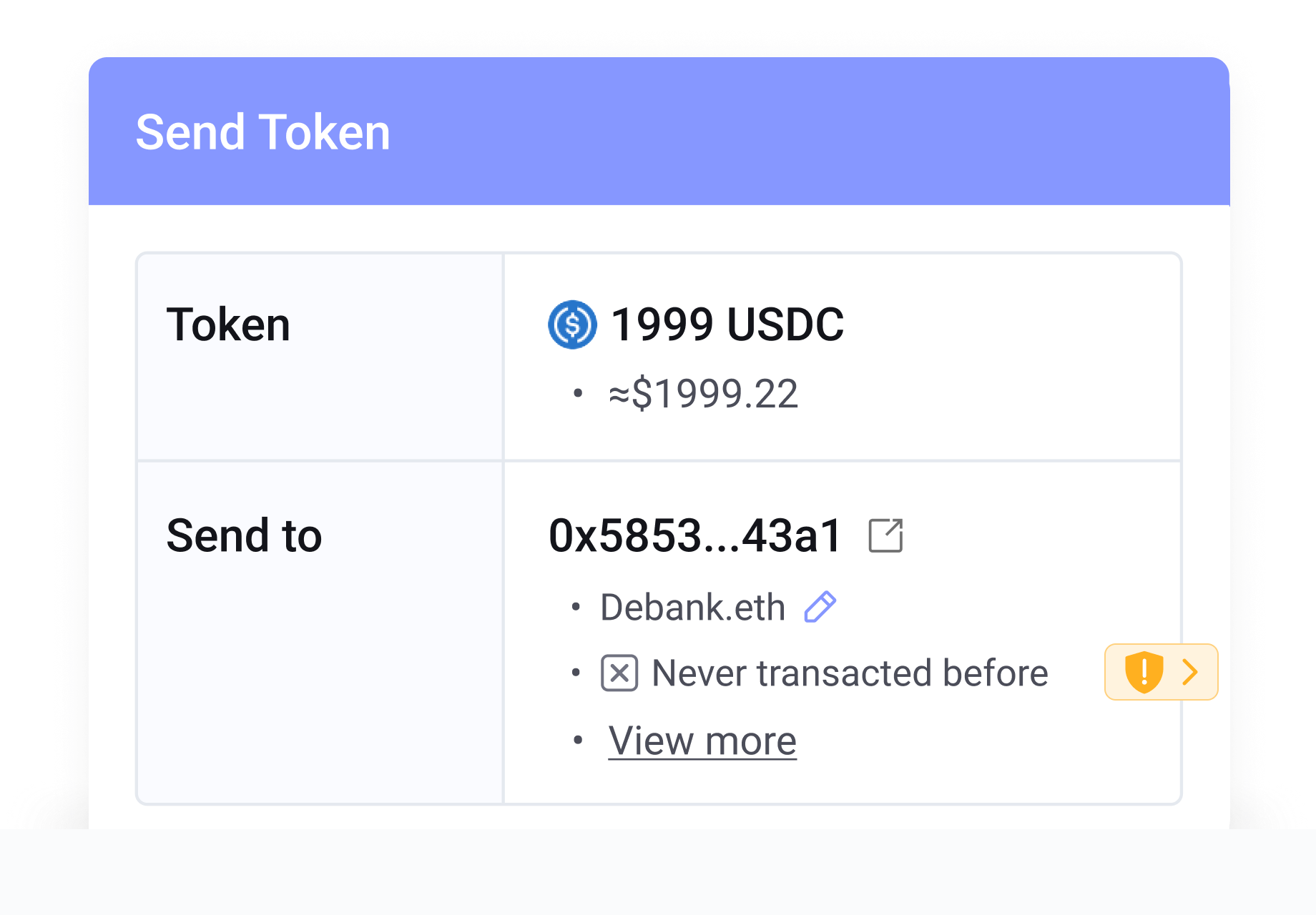
At its root, simulation is local execution of a proposed transaction against a model of the blockchain state. Instead of sending a signed transaction to the network and hoping for the best, the wallet constructs the raw transaction and executes it in a sandbox against recent on-chain data. The sandbox returns the same outputs a miner/validator would: whether the transaction would revert, gas consumed, token transfers, and state changes visible at the EVM level. A thoughtful implementation surfaces these outputs as estimated token balance changes and precise fee costs.
Why this matters mechanistically: many dangerous flows rely on ambiguity. An ERC-20 approval looks harmless in the UI («approve unlimited») but, if paired with a malicious contract call, can drain tokens. Simulation collapses that ambiguity by showing the net effect on balances prior to any signature. That converts what was a probabilistic hazard into a deterministic preview you can evaluate.
What simulation prevents — and its boundary conditions
Simulation reduces three common classes of risk:
– Blind approvals and unexpected token drains: You can see the exact token deltas that would occur if the contract is executed.
– Fee surprises: The simulation reports estimated gas and fiat-equivalent costs so you don’t accidentally pay a large cross-chain fee.
– Nonexistent recipients and obvious reverts: Simulators can flag transactions that will revert or send funds to zero-addresses.
But simulation is not a panacea. Important limits and trade-offs:
– Fresh state mismatch: Simulation uses recent node state; if mempool ordering or state changes between simulation and actual submission (e.g., front-running, sandwich attacks, or competing bot executions), the real outcome can differ.
– Off-chain or oracle dependencies: If a contract relies on off-chain data or deferred oracle updates, simulation might not predict downstream effects that occur after on-chain settlement.
– Signed meta-transactions and relay services: If a dApp submits a signed payload to a relayer, simulation of your local signature may not capture relayer behavior or replay risks unless the wallet models the relayer step.
Understanding these limits is essential: simulation converts several unknowable outcomes into inspectable ones, but it cannot eliminate dynamic, time-sensitive attacks or modeling gaps.
Rabby Wallet’s implementation: a layered-security perspective
Rabby combines transaction simulation with complementary protections that matter to power users. The wallet runs a pre-transaction risk scan to flag known bad contracts, suspicious approval requests, and malformed recipient addresses. It displays the estimated token balance changes and fee cost from a simulated run, preventing blind signing in many common exploit patterns. The product is open-source under MIT, so external auditors and developers can verify simulation logic and risk rules—an important trust signal for institutional users in the US where auditability affects procurement and compliance reviews.
Rabby also bundles other practical features that change operational trade-offs: automatic network switching removes an operational friction that otherwise causes users to submit txns on the wrong chain; built-in approval revocation lets you undo exposures discovered after the fact; and hardware wallet integrations preserve key isolation while still delivering simulation previews. For firms, multi-sig and enterprise integrations (Gnosis Safe, Fireblocks, Amber, Cobo Wallet) mean simulation can be integrated into approval workflows without conceding custody.
It is worth noting a sober historical lesson: Rabby experienced a smart contract exploit in 2022 related to a swap contract, which led to refunds and expanded audits. That incident demonstrates two things—first, cryptographic key safety and a clean codebase are necessary but not sufficient; second, responsive incident processes and public audits materially change the risk calculus for the next exploit. Simulation helps reduce user-level risk but does not retroactively fix flawed smart contracts.
Comparisons and trade-offs: simulation vs. alternative safety strategies
Common alternatives to relying on simulation include strict manual review, hardware-only signing, and limiting approvals to minimal allowances. Each has trade-offs:
– Manual review is slow and error-prone at scale. Simulation scales verification by translating contract logic into a readable balance delta.
– Hardware wallets protect keys but not decision quality: a hardware signer with blind signing is still vulnerable. The ideal is hardware-backed key custody plus simulation preview.
– Minimal approvals reduce exposure but increase UX friction (you’ll approve more often) and can break composability with some DeFi flows. Simulation allows you to use more permissive allowances when the preview shows no harmful deltas—but requires discipline to act on the preview.
For power users, the pragmatic trade-off is layered controls: use hardware custody and multi-sig for high-value accounts, enable transaction simulation to reduce blind-signing risk for day-to-day DeFi interactions, and use approval revocation as a routine hygiene step.
Decision-useful rules and a short checklist
Here are concrete heuristics you can apply today:
1) Never sign an approval without a simulation preview showing zero unexpected outflows. If the preview shows token transfers you don’t recognize, revoke and investigate.
2) Use hardware wallet integration for hot-contract interactions of high value. Confirm that your wallet still shows simulation results when a hardware device is connected—some integrations only present minimal metadata.
3) Treat simulation as necessary but not sufficient. If a dApp depends on off-chain oracles, assume residual risk and reduce exposure (smaller amounts, time-limited approvals).
4) For institutional flows, require simulation evidence as part of your sign-off. Multi-sig ops should record simulation outputs in approval logs for post-hoc audits.
For DeFi power users evaluating wallets, check three practical signals: does the wallet present token balance deltas clearly (not just raw calldata), is the simulation reproducible for different node providers, and is the code auditable? Open-source licensing (MIT) and hardware compatibility are additional operational filters.
Where this shifts the market and what to watch next
If simulation becomes a baseline expectation, we should see three conditional developments. First, UX will evolve: simulation outputs must be concise and standardized so users and integrations can automate checks. Second, dApp developers may design flows to be «simulation-friendly» (e.g., deterministic, less reliance on ephemeral off-chain state). Third, attackers will shift toward time-sensitive or oracle-dependent exploits that simulation struggles to predict; watch for growth in those incident types.
For US-based operations, regulatory and compliance teams may start to prefer wallets with auditable simulation for custody and incident response. That could influence vendor selection in institutional procurement where proof of pre-transaction checks reduces operational risk.
If you want a hands-on place to start evaluating wallets with these features, check out this browser extension that emphasizes simulation and pre-transaction scanning: rabby. Note the caveats above: simulation helps a lot, but it’s part of a layered defense rather than a single silver bullet.
FAQ
Does transaction simulation stop front-running or sandwich attacks?
No. Simulation shows what would happen at the current chain state but cannot predict mempool ordering or adversarial transactions submitted between simulation and confirmation. It reduces certain classes of risk (blind approvals) but not microstructure attacks tied to timing and ordering.
Can simulation be spoofed by a malicious dApp or node provider?
Possibly, if the wallet relies on a single untrusted node or if the dApp returns fabricated metadata. Good practice is for wallets to run simulations against reputable node providers or locally cached state and to be open-source so the simulation logic is auditable. Rabby’s open-source architecture helps here, but users should still prefer diversified node providers when possible.
To conclude: simulation changes the decision surface for DeFi users. It converts many previously speculative dangers into inspectable outcomes, enabling faster, safer interaction with complex multi-chain DeFi. But like any security control, it must be combined with good custody, operational discipline, and an appreciation of its limits. For power users operating in the US, the practical test is simple: can the wallet show you, in human terms, what signing this will do to your balances? If the answer is yes, you’re a step closer to closing the blind-signing gap.


